
Vis Medicatrix Naturae: How One Principle Shapes Every Clinical Decision in a Doctoral Curriculum
Vis medicatrix naturae, the healing power of nature, is the principle that a living organism carries an ordered capacity to regulate and repair itself, and that this capacity operates under conditions and within limits. Held precisely, it changes three things in practice: what a practitioner assesses, the order in which elements of a plan are selected, and the questions asked during case-taking and at follow-up. Remove the obstacle, restore the condition, support the capacity, then target the remainder. KCNH teaches the foundational principles of natural health at this level of working detail.
The phrase arrives early. It sits in the opening pages of nearly every foundational text in natural medicine, usually set in italics, usually followed by a translation in parentheses: vis medicatrix naturae, the healing power of nature. A student reads it, underlines it, and moves on to the material that looks more substantial. Months later, that same student is working through a written case, weighing two reasonable courses of action against each other, and discovers that the line which seemed decorative is the thing deciding between them.

That gap is worth naming, because it is where most people meet this principle and where most people leave it. Vis medicatrix naturae is quotable. It fits on a wall, on a syllabus cover, in the first minute of an introductory lecture. What it is not, in that form, is useful. A principle that changes no decision is decoration. The question separating a student who has memorized the phrase from one who has studied it is narrow and practical: when you are holding an actual case, what does this principle require you to do differently?

What the Principle Actually Claims
Stated precisely, the principle holds that a living organism carries an ordered, self-regulating, self-repairing capacity, and that recovery is something the organism performs rather than something applied to it from outside. The practitioner’s work, on this view, is to identify what obstructs that capacity, remove what can be removed, and supply what the capacity lacks. The claim is about where the work of recovery actually happens.
The phrase itself is old. It reaches modern natural medicine through the Hippocratic writings, travelled through centuries of European medical thought, and was carried into the naturopathic tradition in the late nineteenth and early twentieth centuries as one of a small set of organizing commitments. Its age is not the argument for it. Its age is the reason it has to be restated carefully, because a phrase repeated for two thousand years accumulates meanings it never originally carried, and a serious student has to strip those off before the principle can be examined at all.
Three things the principle does not claim are worth stating just as plainly, because the caricature circulates more widely than the principle. It does not claim that every condition resolves on its own. It does not claim that intervention is unnecessary, or that doing less is always doing better. And it does not claim that natural is a synonym for gentle or harmless. The principle is a statement about mechanism and about where leverage sits, not a promise about outcomes.
The mechanism claim is not exotic. Ordinary tissue repair proceeds through four overlapping phases, hemostasis, inflammation, proliferation, and remodeling, without anyone instructing the tissue to do so. No practitioner closes a wound. The practitioner keeps it clean, keeps it perfused, keeps the person nourished, and the ordered process does the closing. That is the principle in its least controversial form, and it is the form a student should hold in mind when the same reasoning gets applied to systems that are far less visible.
Fever is the more instructive example, because it is where the principle changes how a finding gets read. The febrile response has been conserved across warm-blooded and cold-blooded vertebrates for more than 600 million years, runs on integrated physiological and neuronal circuitry, and confers a survival benefit during infection, with febrile temperatures stimulating both innate and adaptive immune responses. A student holding the principle does not look at an elevated temperature and see only a number to be brought down. The student sees an output of an ordered response and asks what that response is accomplishing before deciding anything at all.
The same body of research supplies the discipline that keeps the principle honest. Recovery of the gut microbial community after a course of antibiotics depends on the nature, timing, duration, and spectrum of the exposure, and on host factors including age, diet, and underlying illness. Capacity is real, and capacity is conditional. Both halves of that sentence are the principle. A student who holds only the first half becomes an optimist. A student who holds only the second half becomes a technician. The discipline is in holding both at once.
How the Principle Shapes Assessment Reasoning
The first place the principle does work is in what gets assessed. A complaint-only assessment asks what is wrong. An assessment shaped by this principle asks two questions at the same time: what is the person presenting with, and what is the current state of the person’s own recovery capacity.
Consider two people with the same presenting complaint and a comparable history. One is over a common cold in three days. The other takes three weeks and is flattened for a month afterward. The complaint is identical. The capacity is not. That difference is not incidental colour in the record. On this principle it is the central variable, and a case record that fails to capture it has left out the thing most likely to determine what happens next.
So the assessment widens in specific ways. Energy is recorded across the day rather than as a single rating, because the shape of the curve says more than the average. Sleep is separated into onset and maintenance. Recovery time is asked about directly: how long after a hard week, a late night, a minor illness, a heavy meal. Digestion, thermal regulation, and how quickly small wounds and bruises resolve all become readings on the same underlying question. And the most underused item in most case records is response to what has already been tried, which is capacity data the person has already generated at no cost to anyone.
This is the part students find counterintuitive. The principle sounds permissive and is in fact demanding. It asks the practitioner to justify any decision that quiets an output without accounting for what produced it. Quieting a signal is sometimes exactly right, and the principle does not forbid it. What the principle forbids is doing it inattentively. Naming the point where capacity is not sufficient on its own belongs to the same reasoning, and a practitione
How the Principle Orders What Gets Selected
The second place the principle does work is in ordering. Once a plan has more than one element, the question is not only what to include but what comes first, and this is where the principle proves most operationally useful.
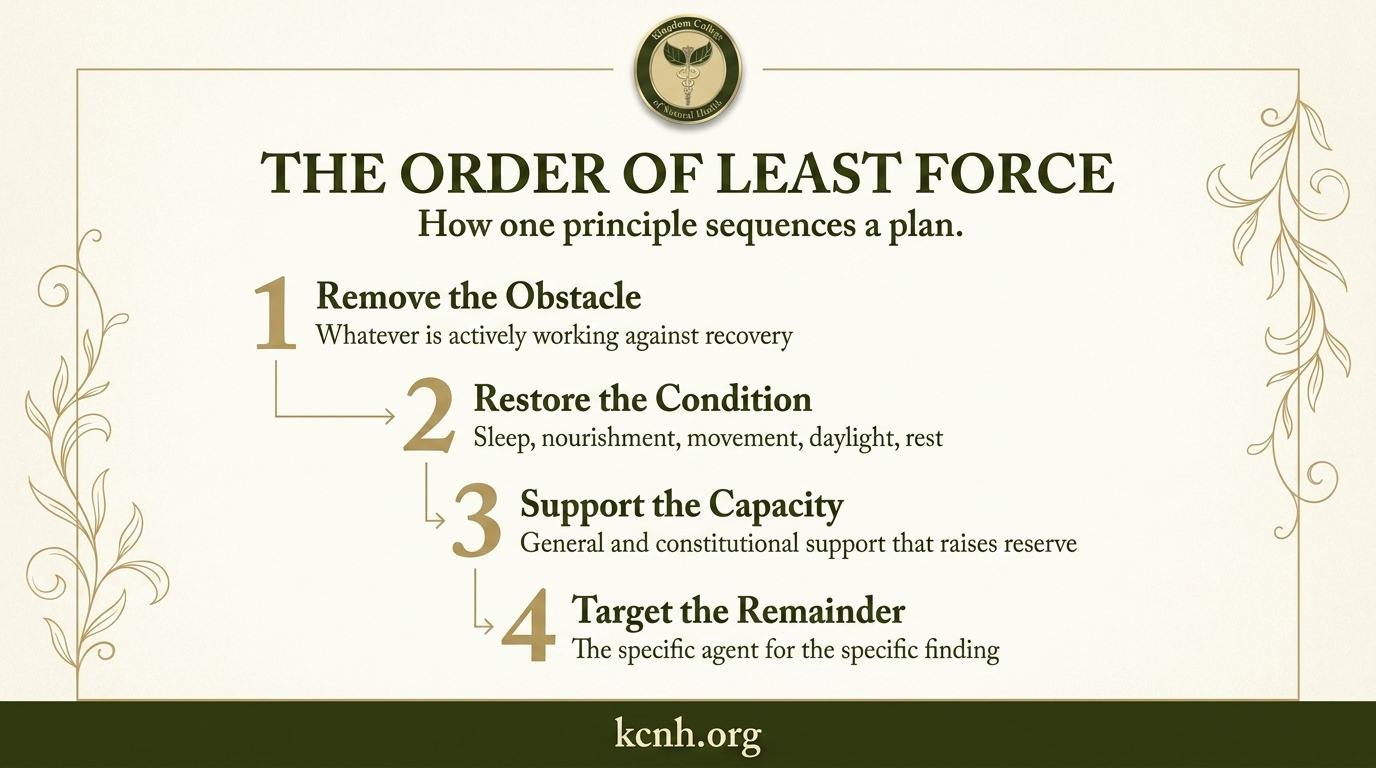
The ordering it produces runs in four steps. Remove the obstacle first: whatever is actively working against recovery, whether that is a chronic sleep debt, a food that is not tolerated, an ongoing load the person has stopped noticing, or a light environment that never signals evening.

Restore the condition second: adequate sleep, adequate nourishment, movement, daylight, actual rest. Support the capacity third, through the general and constitutional approaches that raise the person’s overall reserve. Target the remainder last, with the specific agent aimed at the specific finding.
Most plans that disappoint are plans that started at step four. A carefully chosen herb layered on top of an obstacle nobody removed is not a failure of the herb. It is a sequencing error, and it produces a case record in which nothing appears to work and no one can say why. The principle predicts that outcome, which is one of the reasons it earns its place in a curriculum. It is testable in ordinary practice, week after week, by anyone willing to keep an honest record.
A short example shows what the ordering changes. A person reports afternoon fatigue and asks about an adaptogen. Starting at step four, the practitioner selects the herb, and the case then turns on whether the herb performs. Starting at step one, the practitioner learns that the person has been running on six hours of sleep for two years, eats nothing before two in the afternoon, and recently took on second work. The herb may still belong in the plan. It simply cannot be asked to carry the weight of three unaddressed obstacles, and knowing that in advance is what keeps the case record readable six months later.
Two clarifications keep the ordering from being misread. Least force is not least effort. Removing an obstacle is frequently the slowest part of a plan and the part the person resists hardest, while reaching for a bottle is quick. And the ordering sets an evaluation standard as well as a sequence. The measure of whether a plan is working is whether the person’s recovery capacity has moved, not only whether the complaint has quieted. Those two things come apart often enough that a practitioner has to watch for the difference deliberately.

How the Principle Shapes Case-Taking
The third place the principle does work is in the interview itself. Several standard questions in a thorough case-taking only make sense if the practitioner holds this principle, and a student who does not hold it will ask them mechanically and waste them.
What was happening in the twelve months before this began? The question assumes that obstruction usually precedes presentation, sometimes by a long interval.
When were you last genuinely well, and what was different then? The question sets the person’s own former baseline as the target rather than a population norm. What have you already tried, and what happened each time? That is response data, and it is often the highest-yield material in the entire record. How long does it take you to get over a cold, or a hard week? That is a direct probe of the variable the principle says matters most. And what gets in the way of sleeping, eating, or moving the way you would want to? That is an obstacle inventory in the person’s own words, which is the only form in which it is actionable.
The follow-up visit is where the reasoning gets tested. A student schooled only on complaints will ask whether the complaint is better and record the answer. A student holding the principle asks whether recovery capacity has changed: whether the person is getting over things faster, sleeping through, recovering from exertion, running warmer or cooler than before. A complaint quieting while capacity sits unchanged is a specific and familiar result, and it usually means an obstacle is still in place.
Why a Curriculum Teaches This as Reasoning
A principle earns its place in a degree program only if it changes decisions that can be examined. That is a higher bar than being memorable, and it is why this material sits early in doctoral coursework rather than in a preface. Students are asked to show the principle doing work: to write a case analysis in which the ordering is visible, to say why this element before that one, and to defend the sequence when a reader pushes back on it.

Separating the principle from its caricature is itself part of the academic work. The caricature says the body always heals. The principle says an organism carries ordered capacity that operates under conditions and within limits, and that the practitioner’s leverage lies precisely in those conditions and limits. The first version cannot be argued with and therefore cannot be studied. The second version can be specified, applied, and found wanting in a particular case, which is exactly what makes it teachable.
It is also not a solitary principle. Vis medicatrix naturae sits alongside the other foundational commitments of the tradition, and in practice it is inseparable from the requirement to address causes rather than outputs and from the requirement to proceed with the least force a case allows. Studied together, they stop being a list to recite and start being a working method. That is the whole distance between a student who can quote the phrase and a graduate who can use it.
This kind of reasoning, holding a principle precisely enough that it changes what you ask, what you select, and in what order, is what degree-level study in natural health is for. KCNH educates natural health students and graduates who want the foundational ideas of the field examined at that depth, across Bachelor’s through Doctoral degree programs at an institution that has been doing this work since 1993.