
Where Phytotherapy Meets Pharmacology: Pharmacognosy, Herb-Drug Interactions, and Clinical Reasoning
This article explains where phytotherapy and pharmacology meet. It covers pharmacognosy and the medicines first drawn from plants, how herb-drug interactions arise when an herb speeds up or slows down the liver and intestinal enzymes that clear a drug or acts on the same body system as the drug, and the reasoning that follows: a complete medication and supplement history, checking each pairing against reliable references, and taking any interaction question to the prescribing clinician. It is published on the KCNH blog.
The intake form has a line labeled Current Medications and Supplements, and on this one the answer runs to six entries. Three are prescriptions: a statin, a blood pressure medicine, and a daily aspirin. Three were bought without one: a magnesium supplement, a chamomile tea taken most evenings, and St. John’s wort, started about six months ago on a friend’s suggestion to lift a low mood through the winter. To the client, the two halves of the list belong to different worlds, one from the pharmacy counter and one from the health food store. To anyone who has studied how plants act in the body, it is one list, and the most important question on the form is how its entries meet.
That question sits where two disciplines meet that are often imagined as opposites. Phytotherapy, the study of plants and plant preparations for health, and pharmacology, the study of how drugs act in the body, share far more ground than either side of the store counter tends to assume.

Many medicines began as plants, and many plants act through the same enzymes and receptors that medicines do. For the practitioner, coach, or serious student who works with herbs, understanding that meeting point is what makes it possible to think clearly about a list like this one.
Pharmacognosy: Where the Two Disciplines Share a Root
Pharmacognosy is the study of medicines and medicinal substances derived from natural sources, above all from plants. The discipline asks a precise set of questions. Which plant is it, and which part of the plant? Which constituents does it contain, and how do they vary with growing conditions, harvest, drying, and preparation? Which of those constituents account for the plant’s activity in the body? It sits underneath both the herbal tradition and much of the modern pharmacy.
The examples are familiar once they are named. Willow bark has a long history of use for aches and fevers, and its constituent salicin led nineteenth-century chemists toward salicylic acid and eventually to acetylsalicylic acid, known to the world as aspirin. In 1785 the English physician William Withering published his account of foxglove, whose cardiac glycosides became the basis of digitoxin and digoxin. In the twentieth century, paclitaxel was isolated from the bark of the Pacific yew, and artemisinin from sweet wormwood, a plant long used in Chinese medicine, work that earned Tu Youyou a share of the 2015 Nobel Prize in Physiology or Medicine. Metformin, one of the most widely used medicines in the world, traces back to galegine, a constituent of goat’s rue, a plant used in European folk practice.
The lesson a student draws from this history is not that herbs are simply weak drugs, or that drugs are simply purified herbs. It is that plants contain real chemistry, and that chemistry keeps working whether it arrives in a cup of tea, a tincture, or a pharmacy bottle. The same constituents that make an herb worth studying are the ones that allow it to meet a medicine in the body. This is where casual herb use and serious phytotherapy part ways. Casual use knows an herb by its reputation: good for sleep, good for mood, good for digestion. Serious study knows it by its constituents, its actions, and its documented interactions, and it holds the reputation up against all three.

How Interactions Arise: The Enzymes Herbs and Drugs Share
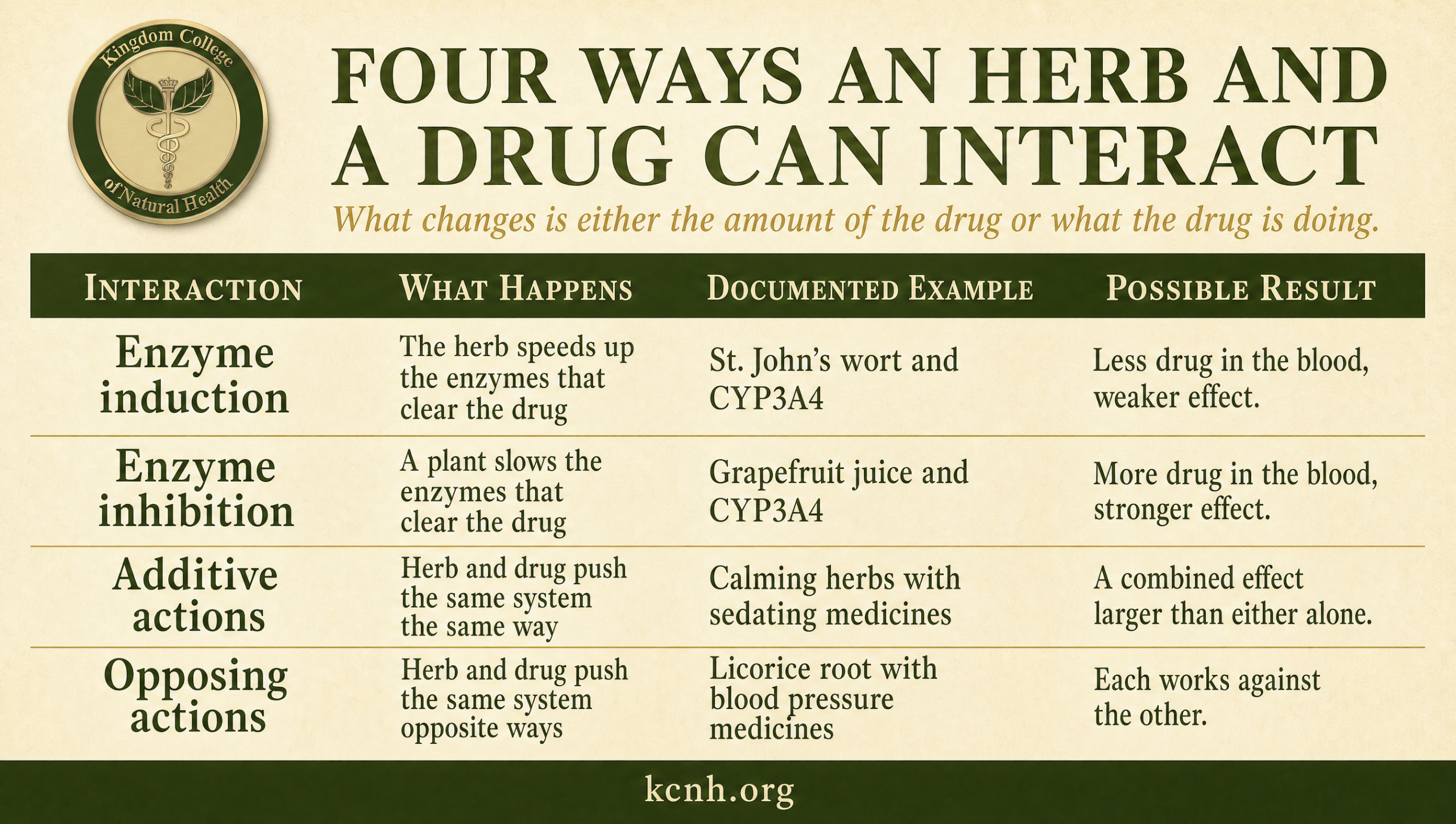
Most well-documented herb-drug interactions work through the way the body clears foreign substances. The liver and the lining of the small intestine carry a family of enzymes known as cytochrome P450, abbreviated CYP, which break down a large share of the medicines in use today along with many plant constituents. One member of the family, CYP3A4, handles more medicines than any other. When an herb changes how active these enzymes are, it changes how much of a drug reaches the bloodstream and how long it stays there. That is a pharmacokinetic interaction. The herb does not change what the drug does; it changes how much of the drug the body is working with.
An enzyme interaction can run in two directions. The first is induction, in which a substance prompts the body to produce more of an enzyme, so a drug is cleared faster and less of it is available. St. John’s wort is the most thoroughly documented example. A review of cytochrome P450 mediated herbal drug interactions in the EXCLI Journal describes how hyperforin, a constituent of the herb, binds a receptor in liver and intestinal cells called the pregnane X receptor and so promotes the production of CYP3A4, which can reduce the oral bioavailability of many drugs. In plain terms, a medicine that was holding at a steady level may be cleared faster once the herb is added, and may not work as well. Induction also takes time to build and time to fade, so its effect does not necessarily begin the day an herb is started or end the day it is stopped.
The second direction is inhibition, in which a substance slows an enzyme down, so a drug is cleared more slowly and more of it reaches the blood. The clearest everyday illustration comes not from a supplement but from the breakfast table. In its consumer guidance on grapefruit juice and medicines, the U.S. Food and Drug Administration explains that grapefruit juice can block the action of CYP3A4 in the small intestine, so that more of certain drugs, including some statins and some blood pressure medicines, enters the blood and stays in the body longer. The same guidance describes a second mechanism working the other way: grapefruit juice can also affect proteins called drug transporters, so that less of some other drugs enters the blood. A familiar fruit can raise the level of one drug and lower another, a useful correction for anyone who assumes only concentrated extracts are worth asking about.
The same research also argues for proportion. The EXCLI review reported that several widely used herbs, among them echinacea, garlic, and milk thistle, did not act as potent or moderate inhibitors or inducers of these enzymes at commonly recommended amounts. An herb’s reputation for interactions, alarming or reassuring, is no substitute for knowing which mechanism is in question and how strong the evidence for it is.
When Actions Add Up or Pull Against Each Other
Not every interaction runs through enzymes. A pharmacodynamic interaction happens when an herb and a drug act on the same system in the body, whatever their levels in the blood. Here the question is not how much of the drug is present but whether the herb pushes the same physiological process in the same direction, or in the opposite one.
Additive interactions are the more intuitive kind. An herb with a calming, sedative action taken alongside a sedating medicine can produce a combined effect larger than either alone.

Herbs with documented effects on platelets or clotting raise the same kind of question beside an anticoagulant such as warfarin, or beside the daily aspirin on the intake form from the opening. St. John’s wort appears again here. Beyond its enzyme effects, the National Center for Complementary and Integrative Health notes that taking it with certain antidepressants or other drugs that affect serotonin may lead to increased serotonin-related side effects, which can be serious.
Opposing interactions are easier to miss, because nothing dramatic happens at once. Licorice root is a classic teaching case. Its constituent glycyrrhizin can lead the body to retain sodium and lose potassium, which can raise blood pressure and work against a medicine taken to lower it. In each case the herb and the drug may both be doing exactly what they are known to do. The difficulty is that they are doing it to the same system at the same time.
The two kinds of interaction can also meet in a single plant, as St. John’s wort shows by appearing in both categories. Learning to ask both questions of every pairing is one of the habits that marks serious study of phytotherapy. Does this herb change the amount of the drug in the body? Does it change what the drug is doing?

Clinical Reasoning: From a Full History to the Prescriber
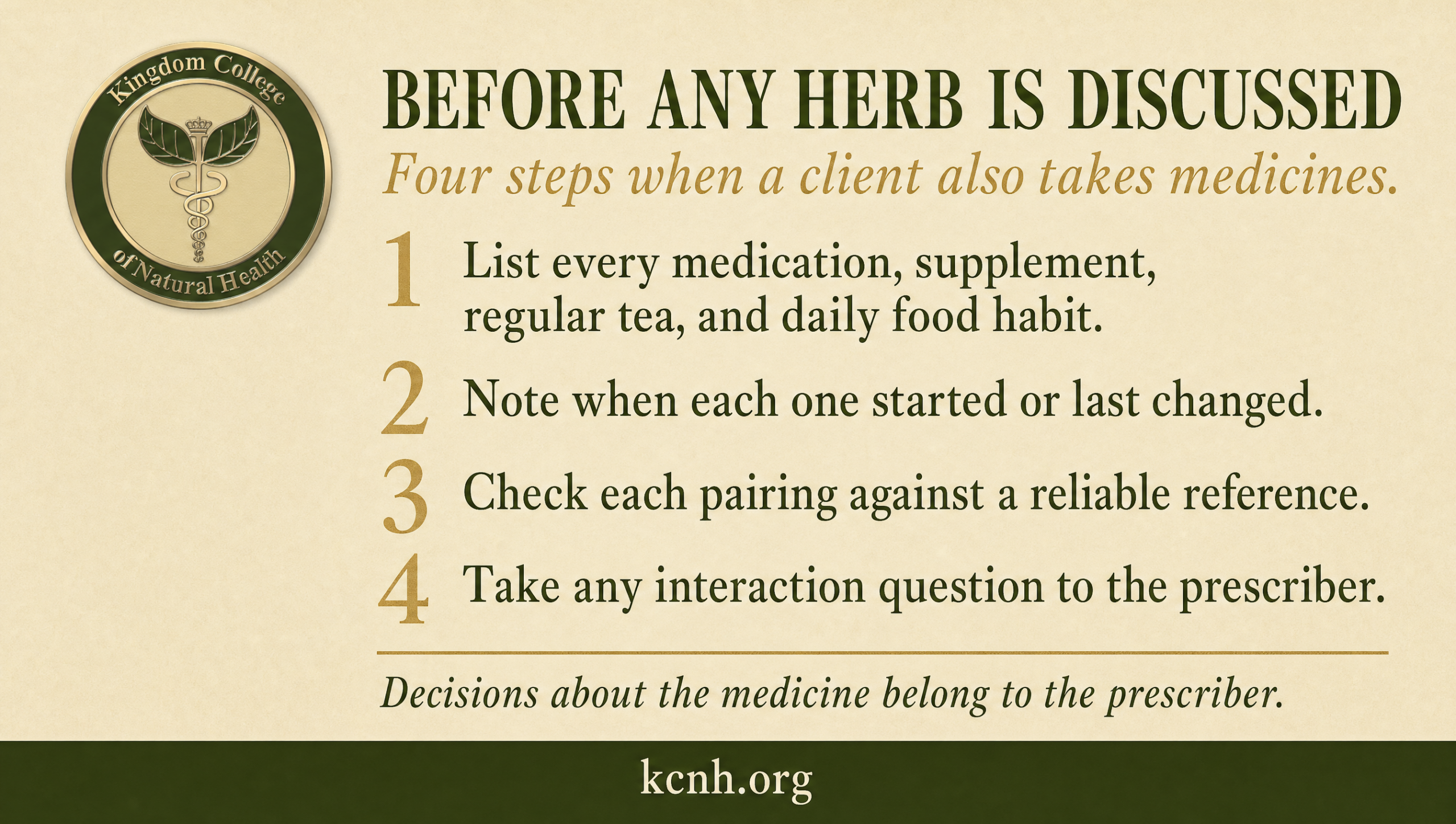
Knowing the mechanisms matters only if it changes what happens in front of a real list. Clinical reasoning in this area follows a sequence, and the first step is the one most often skipped: a complete medication and supplement history. That means every prescription medicine, every over-the-counter product, every vitamin, mineral, and herbal supplement, any tea taken regularly, and daily food habits such as grapefruit juice at breakfast. It also means noting when each one started, because a new entry on either side of the list is where a question most often arises. Clients often leave supplements and teas off a medication list because they do not think of them as medicine, so the question has to be asked plainly.
The second step is checking each pairing against reliable references rather than memory or a single website. Government and academic sources, such as the herb fact sheets published by the National Center for Complementary and Integrative Health, are a sound starting point, alongside established interaction references and the primary research behind them. Checking also means weighing what is found. An interaction predicted from a shared enzyme is different from a single published case report, and both are different from a controlled study showing a measurable change in drug levels. A careful student records not only whether an interaction is listed but how strong the evidence for it is.
The third step is coordinating with the prescriber, and it is where the limits of the work matter most. An herbal practitioner does not advise a client to stop, reduce, or change a medication, and does not adjust anything on the prescription side of the list. When a possible interaction turns up, the question goes to the clinician who prescribed the medicine, ideally in writing: the herb, the form it is taken in and for how long, the medicine it may affect, and the reference that raised the concern. The client is encouraged to bring the same information to that clinician directly. This is not a retreat from the herbal side of the work. It lets everyone involved in the client’s care work from the same complete list.
Return to the intake form from the opening. Someone reading it with this grounding would notice that St. John’s wort is known to induce CYP3A4, that some statins are cleared through that same enzyme, and that the herb interacts with so many medicines that the National Center for Complementary and Integrative Health advises anyone taking medicine to talk with a health care provider before using it. That reader would also hold the daily aspirin in mind before any herb with effects on clotting entered the conversation. None of this produces a recommendation about the medicines. It produces a clear, documented question for the prescriber, and a pause on discussing any new herb until that question has an answer. The chamomile tea and the magnesium still get checked, and the skill lies in weighing what each check turns up, so that a list of six entries produces a few focused questions rather than six vague worries.
What Serious Study Adds to Working With Herbs
Casual herb use and academic phytotherapy can involve the same plants, the same teas, and the same tinctures. The difference lies in what the person knows about them. Casual use asks whether an herb is natural and whether it has a good reputation. Serious study asks what the herb contains, how those constituents act, which enzymes and body systems they touch, what the evidence says about interactions and how strong that evidence is, and how all of it bears on a person who is also taking medicines. The first is enough for an evening cup of tea. The second is what working beside someone else’s medicines requires.
That second approach rests on several kinds of grounding at once. It needs botany, to know which plant and which part of it is in the jar. It needs pharmacognosy, to know which constituents matter and how preparation changes them. It needs enough physiology and pharmacology to follow an enzyme from a textbook diagram into a living person, and enough research literacy to tell a predicted interaction from a documented one. None of this replaces the herbal tradition. It gives the tradition a shared language with the medicines a client already takes, and it allows a question to reach a prescriber clearly and precisely.
It also changes the posture a student brings to the field. The goal is not to be more cautious about herbs, or less, but to be accurate about them: confident where the evidence supports confidence, careful where it calls for care, and clear about which questions belong to someone else.
Studying herbs this way, as plants with real chemistry that meets real medicines, with the history, mechanisms, and reasoning to match, is the kind of academic grounding KCNH has offered since it was established in 1993. KCNH educates natural health students and graduates who want to understand where the herbs they study meet the medicines their clients take.