Three Ways to Read a Constitution: Ayurveda, Traditional Chinese Medicine, and Homeopathy Compared
This article compares three constitutional frameworks used in natural health: the three doshas of Ayurveda, the five elements of Traditional Chinese Medicine, and the constitutional remedy pictures of homeopathy. It explains what each framework reads, how each separates a person’s enduring nature from their current state, where the three agree and differ, and what current research can and cannot say about them, as published on the KCNH blog.
Ask an Ayurvedic practitioner, a practitioner of Traditional Chinese Medicine, and a classical homeopath to describe the same person, and three different vocabularies will come back. One may speak of a strong pitta constitution with vata rising this season. Another may describe a person whose Wood element is prominent and whose Earth element is under strain. The third may say the person fits the picture of a particular constitutional remedy. Each description is careful, internally coherent, and grounded in long observation, and to anyone outside the tradition each sounds like a different language.
For a practitioner, a coach, or a serious student who draws on more than one tradition, that moment raises a real question. Are these three frameworks describing the same person in different words, or are they noticing different things altogether? The answer is some of each, and working it out is one of the most rewarding exercises in natural health study. Comparing the doshic, five-element, and homeopathic frameworks side by side shows what each one is built to see, where they quietly agree, and where the honest differences lie.

Ayurveda: Reading Qualities Through the Three Doshas
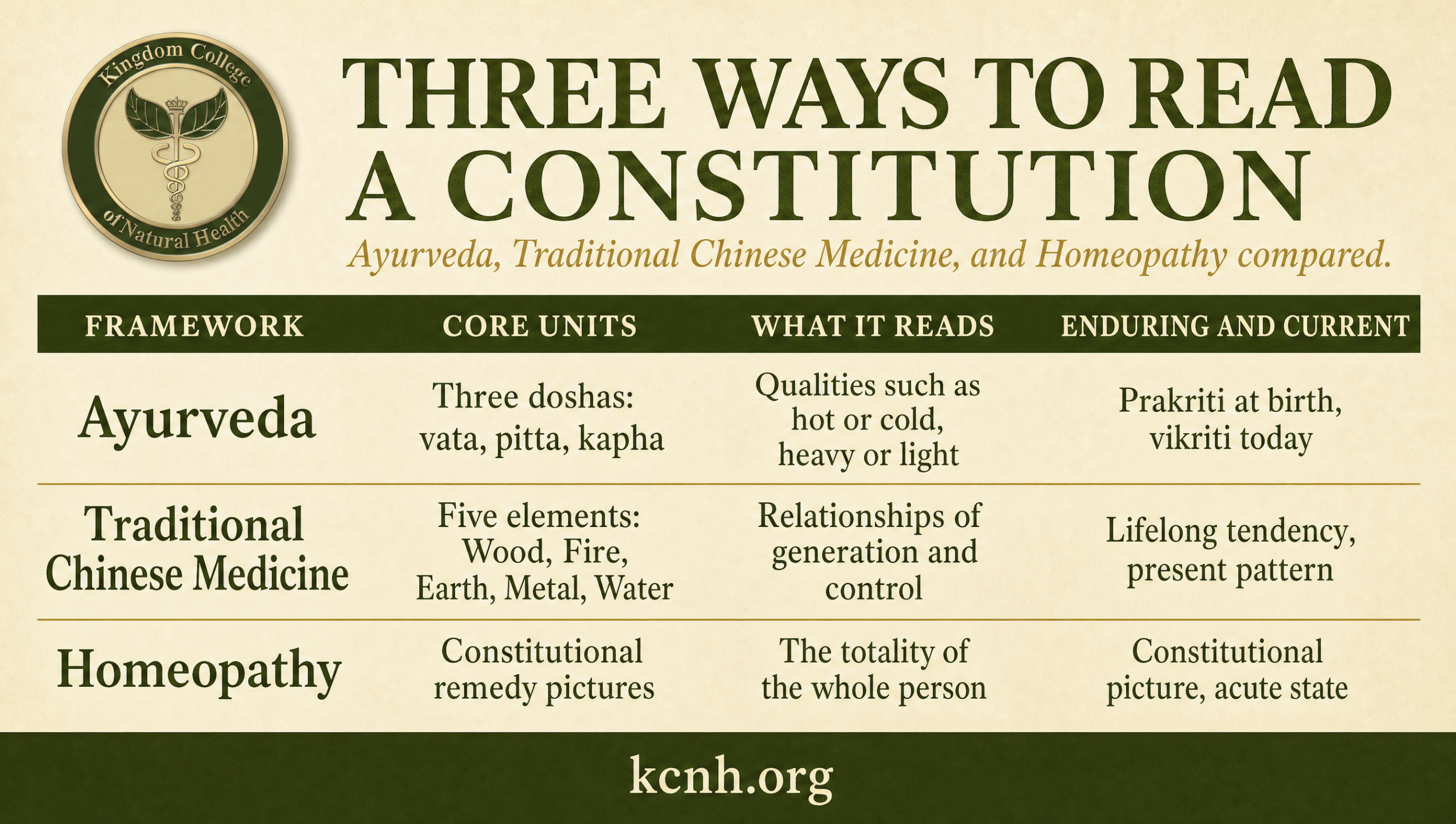
Ayurveda begins with five great elements, space, air, fire, water, and earth, and groups them into three doshas, the functional principles through which those elements show up in a living person. Vata combines space and air and governs movement. Pitta combines fire and water and governs transformation, including digestion and metabolism. Kapha combines water and earth and governs form, cohesion, and stability. Every person carries all three, in proportions that differ from one person to the next.
What makes the doshic framework distinctive is that it reads qualities. Vata is described as dry, light, cold, rough, and mobile; pitta as hot, sharp, light, and oily; kapha as heavy, slow, cool, oily, and stable. An Ayurvedic assessment looks for those qualities everywhere: in body build, skin and hair, appetite and digestion, sleep, speech, temperament, and response to weather and season.
The organizing principle is simple to state and demanding to apply. Like increases like, and opposites bring balance, so a person who already carries a great deal of cold, dry, mobile quality is likely to feel a cold, dry, windy season more keenly than someone whose constitution runs warm and steady.
Ayurveda also draws a distinction that the other two frameworks echo in their own terms. Prakriti is the constitution a person is born with, generally described as stable across life. Vikriti is the current state, the way the doshas stand today after the influence of diet, season, age, stress, and circumstance. Classical sources describe seven prakriti types, single-dosha, dual-dosha, and the rare balanced type, and much of the skill of Ayurvedic study lies in telling the enduring nature from the passing state, so that a seasonal imbalance is not mistaken for who the person is. Assessment draws on observation, detailed questioning, and the reading of the pulse, a skill classical sources describe as one developed over years of practice rather than learned in an afternoon.
Traditional Chinese Medicine: Five Elements and the Relationships Between Them
Traditional Chinese Medicine offers a different kind of map. The five elements of Chinese medicine, Wood, Fire, Earth, Metal, and Water, are understood less as physical substances than as qualities of movement and change in nature and in the person. Each is associated with a season, a climate, an emotion, a taste, and a pair of organ systems: Wood with spring, the liver, and the gallbladder; Fire with summer, the heart, and the small intestine; Earth with late summer, the spleen, and the stomach; Metal with autumn, the lungs, and the large intestine; and Water with winter, the kidneys, and the bladder. The organ names refer to functional systems in the Chinese sense rather than to anatomy as a Western textbook describes it, which is one of the first conceptual adjustments a student makes.
Where Ayurveda reads qualities, the Chinese five-element framework reads relationships. In the generating cycle, each element nourishes the next: Wood feeds Fire, Fire produces Earth, Earth gives rise to Metal, Metal gives rise to Water, and Water nourishes Wood. In the controlling cycle, each element restrains another: Wood restrains Earth, Earth restrains Water, Water restrains Fire, Fire restrains Metal, and Metal restrains Wood. A five-element reading therefore asks not only which element is prominent in a person, but how the elements are interacting, which one is overacting, which one is being drained, and where the cycle has lost its balance.
Chinese medicine also has constitutional theory in the narrower sense. The five-element acupuncture tradition associated with J.R. Worsley looks for a person’s causative factor, the one element understood to sit at the root of their constitutional imbalance across life. Separately, contemporary researchers have formalized body constitution into nine types: balanced, qi-deficient, yang-deficient, yin-deficient, phlegm-dampness, damp-heat, blood stasis, qi stagnation, and an inherited special type. These are assessed with the Constitution in Chinese Medicine Questionnaire, a sixty-item instrument that a 2022 validation study described as probably the most comprehensive and widely used of its kind, and that has been translated and used in several countries, including the United States.
Homeopathy: The Constitution as a Whole-Person Picture
Homeopathy approaches constitution from yet another direction. Samuel Hahnemann, who founded the system around the turn of the nineteenth century, asked the practitioner to take in the totality of a person’s symptoms rather than a single complaint. Later homeopaths, most influentially James Tyler Kent, developed that idea into constitutional prescribing: the search for the single remedy whose picture best matches the whole person, including temperament, emotional patterns, food cravings and aversions, sleep, sensitivity to heat and cold, and the way symptoms shift with the time of day or the weather.
In this framework the constitution is described not by elements or qualities but by remedy pictures, detailed portraits drawn from provings and long observation and cataloged in the materia medica.

A student learns, for example, the chilly, steady, methodical picture traditionally associated with Calcarea carbonica, and how it differs from the warm, expansive, often untidy picture associated with Sulphur. Kent’s approach also ranked symptoms in a hierarchy, with mental and emotional features and the general symptoms that affect the whole person placed above local, particular ones. Those symptoms are organized in a repertory, a vast index that lets a student work from a person’s symptoms toward the remedies that share them.
Homeopathy draws its own version of the enduring-versus-passing distinction. A constitutional picture describes the person across time; an acute picture describes a temporary state that may look quite different from the person’s usual nature. As in Ayurveda, a large part of the skill lies in not confusing the two.

Where the Three Frameworks Agree, and Where They Part Ways
Set side by side, the three frameworks share more than their vocabularies suggest. All three distinguish a person’s enduring nature from their present state. All three ask about the same everyday territory: whether the person runs warm or cold, how appetite and thirst behave, how sleep goes, what the temperament is like, and how the person responds to seasons and weather. The thermal axis is a good example. Ayurveda reads it through the heat of pitta and the cold of vata and kapha, Chinese medicine through the balance of yin and yang and constitutions such as yang deficiency, and homeopathy through general symptoms such as chilliness or intolerance of heat. Three traditions, developed largely independently, each concluded that whether a person feels the cold is worth asking about.
The differences are just as instructive. Ayurveda classifies by qualities, and a dosha can be described almost entirely in adjectives.
The Chinese five-element framework classifies by relationships, and a reading is incomplete until it says how the elements are acting on one another. Homeopathy individualizes furthest, aiming for the one remedy picture that fits a single person rather than a category that many people share. The frameworks also differ in what the reading is for. In Ayurveda it guides diet, daily routine, and seasonal habits; in Chinese medicine it shapes how patterns are understood over time; in homeopathy it directs the choice of remedy.
A single example shows how the three readings can sit together. Picture a person who is slender, quick-moving, and quick-thinking, who feels the cold, sleeps lightly, and grows restless and scattered when routines slip in late autumn. An Ayurvedic reading would likely notice a vata-predominant constitution meeting a vata season. A five-element reading might look at the relationship between Water, the element of winter and of stored reserves, and Wood, the element that Water nourishes, and ask whether reserves are being spent faster than they are replenished. A homeopathic reading would look past the features this person shares with many others toward the particulars that set them apart, the specific fears, cravings, and sleep habits, before considering which constitutional picture fits. None of the three readings cancels the others. Each directs attention to something real, and a student fluent in all three sees more of the person than a student fluent in only one.
The most common mistake a student makes with any of these frameworks is typecasting: reading a type instead of a person. A constitutional label is a starting hypothesis, a way of organizing observation, never a substitute for it. Students who study more than one framework often find this mistake easier to avoid, because holding three descriptions of the same person makes it plain that each is a lens rather than the whole truth.
What the Research Can and Cannot Say
A serious comparison also has to be honest about evidence, and the three frameworks stand in different places. The doshic framework has drawn some of the most interesting recent attention. A 2008 study in the Journal of Translational Medicine examined gene expression and biochemistry across contrasting prakriti types in healthy individuals of the three most contrasting constitutions and reported differences in genome-wide gene expression and in measures that included liver function tests, lipid profiles, and hemoglobin. The authors described the work as showing the promise of integrating Ayurveda with genomics, which is a fair account of where it stands: an early signal of biological correlates, not a validation of the full framework.
Chinese body constitution typing has been examined mainly through questionnaire research.

It also found that two of the nine types, phlegm-dampness and damp-heat, could not be reliably separated in the data and were better combined into one. That is a useful reminder that even well-studied constitutional instruments are still being refined. Homeopathic constitutional typing has been studied far less, and homeopathy’s research base as a whole remains contested, which a careful student acknowledges plainly rather than glossing over.
None of this diminishes the value of studying the frameworks. Each represents centuries of disciplined observation of human variation, and each sharpens the attention a practitioner or coach brings to the person in front of them. What the evidence asks for is proportion: to use constitutional frameworks as organized ways of seeing, to stay curious about where research supports them, and to claim no more for any of them than the evidence allows.
Reading three traditions on their own terms, holding them side by side, and noticing both their agreements and their honest differences is the kind of comparative thinking that serious study in natural health asks of a student. KCNH educates natural health students and graduates who want to understand the traditions they draw on at this depth. The 2022 validation study of the Constitution in Chinese Medicine Questionnaire, conducted with more than 1,500 volunteers in southern China, found reasonably good reliability and construct validity overall.