
Understanding the AHPLEX Exam: Doctorate Degrees By Testing for Qualified Professionals
The AHPLEX Exam at Kingdom College of Natural Health is an academic advanced placement assessment for qualified professionals with substantial prior education. It evaluates doctoral-level knowledge to determine eligibility for advanced standing within a degree program. The exam supports academic rigor without replacing coursework or conferring professional authority.
 Natural health professionals often reach a point where certification and practice experience no longer feel sufficient on their own. Many begin to seek academic depth, formal degrees, or scholarly recognition.
At the same time, returning to a traditional, full-length degree program may feel redundant or impractical for those who already hold substantial education and experience. This tension creates understandable confusion.
The AHPLEX exam exists to address this specific scenario, offering a structured academic pathway for qualified professionals who have already completed advanced education in natural health disciplines.
What the AHPLEX Exam Is
The AHPLEX exam is an academic advanced placement assessment offered by the Kingdom College of Natural Health (KCNH).
AHPLEX stands for “Alternative Health Professional Level Examination” – an academic evaluation process that allows qualified professionals to demonstrate doctoral-level knowledge through comprehensive testing. It is not a shortcut, waiver, or alternative to academic rigor. Instead, it functions as a degree-by-testing entry mechanism for individuals whose prior education already meets advanced academic standards.
The AHPLEX exam allows eligible candidates to enter a doctoral degree pathway with advanced standing.
What “Doctorate Degrees By Testing” Actually Means
 The phrase “doctorate degrees by testing” can easily be misunderstood without context. It does not mean that a degree is granted solely based on passing an exam with no further requirements. It means that the exam is used to assess whether a candidate’s existing education and knowledge meet the foundational doctoral-level competencies typically gained through earlier coursework.
Candidates who do not pass the AHPLEX exam still complete remaining degree requirements through KCNH’s standard academic curriculum.
The exam replaces qualifying coursework, not the entire doctoral program. This distinction is essential for understanding the integrity of the pathway.
Who the AHPLEX Exam Is Designed For
The AHPLEX exam is designed specifically for licensed professionals and practitioners who have passed the ANWPB exam, not entry-level students. Typical candidates include state- or medical-licensed professionals who already hold advanced education and who can demonstrate substantial academic preparation. These professionals are often seeking formal academic recognition that aligns with the depth of knowledge they already possess.
Academic rigor is central to KCNH’s mission. The AHPLEX exam exists precisely because academic standards matter. By rigorously assessing prior learning, KCNH ensures that advanced placement is granted only when appropriate. This protects both the institution and its graduates. The AHPLEX is not intended for beginners or for those without a strong educational foundation. But, rather than lowering barriers, the AHPLEX exam reinforces them in a structured and academically defensible way.
What the AHPLEX Exam Evaluates
 The AHPLEX exam evaluates comprehensive, doctoral-level knowledge across relevant subject areas within natural health. Rather than testing memorization alone, the exam assesses conceptual understanding, integration of knowledge, and academic readiness. It is designed to ensure that candidates entering with advanced placement truly meet the expectations of doctoral study. This evaluative role protects the academic integrity of KCNH’s degree programs.
The AHPLEX exam does not eliminate the need to complete remaining coursework, research, or degree requirements. The doctoral degree is earned through completion of the full program, not through testing alone. It also does not confer professional authority, licensure, or medical standing. The AHPLEX exam is purely an academic mechanism.
How the AHPLEX Pathway Fits Within KCNH
KCNH offers multiple academic pathways to accommodate different student backgrounds. Some students pursue coursework-based degrees from the beginning. Others with extensive prior education may qualify for advanced placement through AHPLEX. Both pathways lead to the same academic standards, degree requirements, and expectations. The difference lies in how prior learning is evaluated, not in the value of the degree.
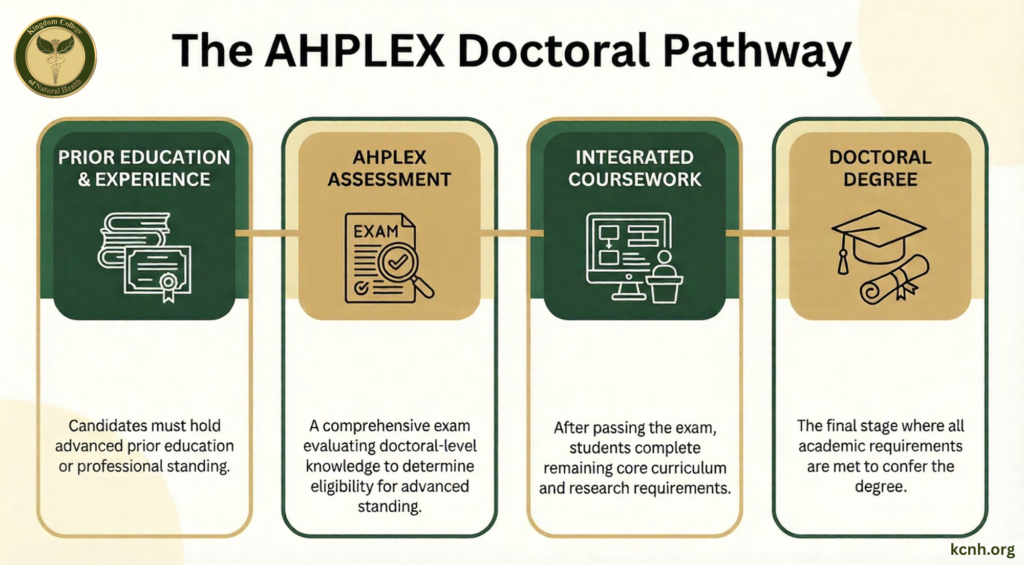
Professionals often explore the AHPLEX option after years of study, practice, or teaching within natural health disciplines. At this stage, the desire is not to bypass education, but to avoid unnecessary repetition while still honoring academic rigor. AHPLEX provides a structured option for doing exactly that.
For many natural health professionals, earning a degree is about intellectual grounding rather than professional permission. Academic degrees contribute depth, scholarly credibility, and personal fulfillment. They do not grant legal authority or clinical rights, and they should not be represented as doing so. Understanding this distinction allows professionals to pursue academic advancement with realistic expectations.
Using the AHPLEX Pathway Responsibly

Like all academic pathways, AHPLEX should be approached with clarity and honesty. Candidates are responsible for accurately representing their credentials, completing all remaining degree requirements, and upholding academic standards throughout their program.
When used appropriately, the AHPLEX pathway becomes a respectful acknowledgment of prior learning rather than an attempt to avoid rigor.
For qualified professionals considering doctoral-level education, reviewing AHPLEX eligibility criteria can help determine whether this advanced placement option aligns with their background. Understanding how prior education is evaluated provides a clearer picture of what the pathway involves.