
Phytotherapy at the Doctoral Level: Plant Constituents, Herbal Actions, and Clinical Application
This article walks through phytotherapy as it is taught at the doctoral level: the constituent classes that explain why plants act in the body, the classical action categories that organize herbal selection, and the clinical reasoning that brings both to work in actual practice. It is written for serious students and working herbalists ready to study plant medicine beyond surface recipes. KCNH offers doctoral and bachelor’s degree programs in natural health that include this depth of study.
The shelves at a working herbalist’s apothecary are full of stories. Ashwagandha for stress. Elderberry for immune support. Holy basil for blood sugar. Valerian for sleep. A weekend course in herbal medicine teaches the recipes that connect those stories to client situations, and for many clients, those recipes work well enough. But a serious student of herbalism who has been at this work for a year, two years, five years, begins to notice the gaps. Why does ashwagandha calm one client and feel stimulating to another? Why does the same elderberry preparation work beautifully in autumn and seem inert in spring? Why does holy basil, supposedly an adaptogen, sometimes act more like a nervine? The recipes do not answer those questions. The plants do, but only when the person dispensing them has studied below the surface.

That deeper level of study has a name. It is called phytotherapy, and at the doctoral level it is the discipline of plant medicine treated as plant medicine actually is: a working body of knowledge about constituents, actions, and clinical application, taught with the depth those subjects deserve. The difference between knowing what an herb is used for and knowing why is the difference a serious student of herbalism is looking for. This article walks through the three domains that organize doctoral-level phytotherapy study, what each contains, and how they shape clinical thinking in actual practice.
A doctoral phytotherapy curriculum organizes its material into three working domains: the constituents that explain why plants do what they do, the actions that name what they do in the body, and the clinical applications that put both to work in a real practice. The domains build on each other. Constituent knowledge undergirds action understanding, and both feed clinical decision-making. What follows walks through each in turn, with the level of specificity a working herbalist actually needs.
Plant Constituents: What Is Actually in the Plant
Every medicinal plant is a chemistry experiment that the plant itself has run over hundreds of thousands of years. The constituents are the secondary metabolites that the plant produces for its own ecological reasons (defense against herbivory, attraction of pollinators, antimicrobial protection of seeds) and that turn out to have pharmacological effects in human physiology. Phytotherapy study begins with the constituent classes because everything downstream depends on them: how a plant acts in the body, what preparation form draws those actions out, what dosing window is therapeutic, what side effects to expect.
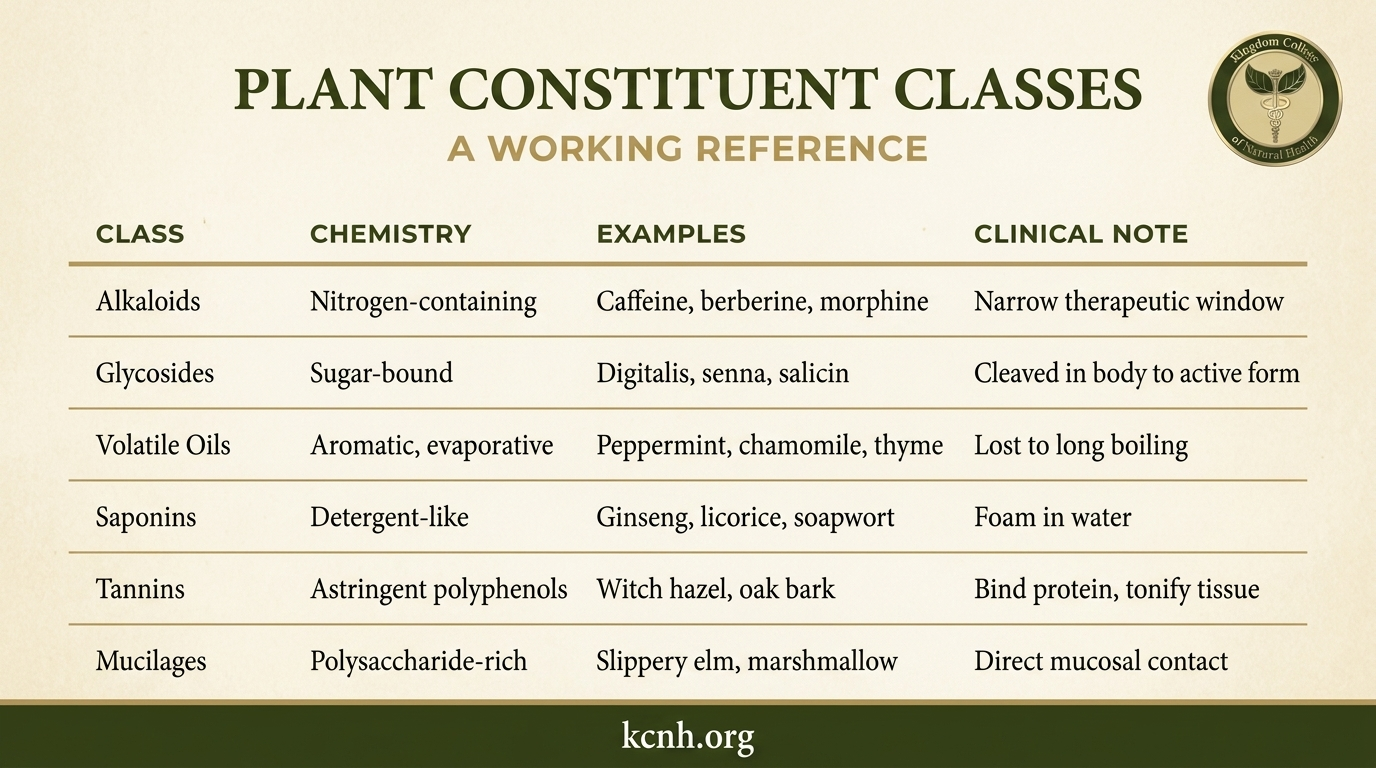
The classical constituent groupings include alkaloids, glycosides, volatile oils, tannins, saponins, polysaccharides, flavonoids, and resins. Each class has characteristic chemistry and characteristic pharmacology.
Alkaloids are nitrogen-containing compounds that bind to specific receptor systems in human tissue. They are the pharmacologically potent fraction of the plant kingdom, and they are also the toxic fraction. Caffeine is an alkaloid. Morphine is an alkaloid. Berberine, hyoscyamine, lobeline, and capsaicin are alkaloids. Alkaloid-containing herbs are dosed carefully because the therapeutic window is often narrow and the difference between a useful dose and a toxic one can be smaller than other constituent classes allow.
Glycosides are constituents bound to a sugar molecule. The sugar is cleaved off in the body, releasing the active fraction. Cardiac glycosides in foxglove (digitalis) inotropically support a failing heart at narrow doses. Anthraquinone glycosides in senna and cascara act on the colon as laxatives. Salicin in white willow is the parent compound of salicylic acid. Knowing that a constituent is a glycoside tells the working herbalist something about how to prepare the herb and how to interpret its action.
Volatile oils are the aromatic constituents responsible for the smell of peppermint, lavender, chamomile, thyme, and rosemary. They evaporate at room temperature, which is why an open jar of peppermint loses potency over time. They are carminative (settling the digestion), antimicrobial, and locally circulatory. Volatile oils are best preserved in tinctures and in fresh-plant preparations; long boiling drives them off entirely.
Saponins are detergent-like constituents that foam in water. They include the ginsenosides of ginseng and the glycyrrhizin of licorice. Tannins are astringent polyphenols that bind to proteins, which is why a strong cup of black tea makes the mouth pucker. Tannins concentrate in witch hazel, oak bark, and red raspberry leaf, and they account for the topical wound-tightening and gut-toning actions of those plants. Mucilages are long-chain polysaccharides that hydrate and form a viscous solution in water; they account for the soothing action of slippery elm, marshmallow root, and aloe.
The constituent profile of an herb is not a trivia category. It is the predictive framework that explains why one preparation form works and another does not, why one dosing range is therapeutic and another is irritating, and why two herbs with similar reputed uses can have opposite clinical effects.
Herbal Actions: What the Plant Does in the Body
If the constituents are what the plant contains, the actions are what the plant does once those constituents reach human tissue. A doctoral phytotherapy curriculum spends considerable time on the action vocabulary, because clinical herbal selection runs through actions, not through “what is this herb used for.”
A short tour of the classical actions illustrates the kind of distinctions a working herbalist holds in mind.
An alterative herb slowly changes the underlying biochemistry of the blood and lymph. Burdock, cleavers, red clover, and yellow dock are alteratives. They are not symptomatic remedies; they are slow constitutional remedies that show their work over weeks of consistent use, often supporting elimination through skin, kidney, and bowel as they go. A practitioner working with a client whose presentation has a slow, deep, terrain-level quality, eczema that has been chronic for years, or recurrent lymphatic swellings, may reach for an alterative even though the client’s chief complaint is somewhere else entirely.
An adaptogen herb supports the body’s nonspecific resistance to stress. The category was defined in the mid-twentieth century by Soviet researchers studying performance under physiological stress, work that established the criteria that still define an adaptogen in the literature today. Adaptogens modulate the hypothalamic-pituitary-adrenal axis. They are not stimulants and they are not sedatives. They include ashwagandha, rhodiola, eleutherococcus, schisandra, and holy basil. The clinical pattern that calls for an adaptogen is the depleted, dysregulated client: the one who is wired and tired, the one whose cortisol curve has flattened, the one whose recovery from illness has stalled.
A demulcent herb is mucilaginous and soothes mucous membranes. Slippery elm, marshmallow root, plantain, licorice, and aloe are demulcents. They are the working herbalist’s tools for the irritated digestive tract, the inflamed urinary tract, the sore throat, the dry cough.
A nervine herb works on the nervous system. Relaxing nervines (chamomile, skullcap, passionflower, oats) calm an overstimulated state without sedating. Stimulating nervines (gotu kola, ginkgo when used for cerebral circulation) bring focus and circulation to the central nervous system. Nervine selection runs on the picture the client presents: a wound-up nervous system in retreat asks for a different category than a sluggish nervous system in need of activation.
This is a partial list. The classical actions extend to carminative, diaphoretic, diuretic, expectorant, hepatic, vulnerary, rubefacient, and several dozen others, with monograph collections such as the European Scientific Cooperative on Phytotherapy monographs codifying the evidence behind many of them. The working vocabulary at the doctoral level includes thirty or forty of these terms, each with its own constellation of representative herbs and its own clinical indication. The vocabulary is what lets a phytotherapist think in plants, not in named conditions.
Clinical Application: Putting Constituents and Actions to Work
The third domain, where constituents and actions meet a person sitting in front of the herbalist, is where doctoral phytotherapy study earns its name. A brief illustration of what that thinking looks like is worth more than a definition.
Consider a client presenting with persistent fatigue, intermittent indigestion, and disturbed sleep. The popular recipe approach offers an obvious set of choices: ashwagandha for the fatigue, ginger for the digestion, valerian for the sleep, and a glass of holy basil tea before bed. That set might help. It also might not, because the recipe is a guess and the underlying picture has not been read.

A working phytotherapist reads the picture first. Is this a deficient client, a stagnant client, or an overactive client? Is the fatigue cortisol-mediated or metabolic? Is the indigestion mechanical or terrain? Is the sleep onset disturbed because of nervous overstimulation or because of an inadequate evening parasympathetic shift? The answers do not all come at once. They come from listening, from a careful intake, from a few exchanges over a few weeks.
Once the picture clarifies, herbal selection follows. A depleted constitutional pattern with a flattened cortisol curve might warrant a sustained course of an adaptogen, often paired with a nutritive (oat straw, nettle seed) to rebuild substrate. A stagnant digestive picture with poor bile flow might warrant a bitter (gentian, dandelion root) taken twenty minutes before meals. A nervous-overstimulation sleep onset might warrant a relaxing nervine taken as a strong evening infusion, not as a capsule, because the constituents responsible for the action are water-extractable and the volume of liquid matters as much as the herb itself.
Preparation form is itself a clinical decision. A volatile-oil-rich aromatic loses much of its action in a hot decoction; a glycerite preserves it. A tannin-rich astringent is fine as a tea but binds protein in a tincture and dulls. A polysaccharide-rich demulcent acts on direct contact with mucous membranes and so is dosed differently from a systemic remedy. Dose, frequency, length of administration, and combination with other herbs are all decisions that follow the constituent and action analysis.
Interactions and contraindications are part of the same framework. Knowing that licorice contains glycyrrhizin that can elevate blood pressure tells the herbalist what to ask about and what to monitor. Knowing that St. John’s Wort induces cytochrome P450 enzymes tells the herbalist what medications to consider before dispensing. The framework is not memorized as a list of warnings; it is reasoned from the same constituent and action profile that explained the action in the first place.

What This Depth of Study Asks of a Student
Doctoral-level phytotherapy study is unhurried. The vocabulary takes time, the herbs take time, the connections between constituents and actions and clinical pictures take time. A weekend course cannot do this work. A doctoral curriculum does the work the way it has to be done: monograph by monograph, action category by action category, with the time and the reference material that a serious study requires. The student who is ready for that level of study is the student who has already noticed the gap between a recipe and an understanding, and has decided that the gap matters.
This kind of working herbal knowledge, where constituents predict actions, actions predict clinical application, and clinical application stays grounded in plant chemistry, is what a doctoral phytotherapy curriculum builds over time. It is the kind of study that asks for an institution with the academic depth and time-tested rigor to teach plant medicine seriously, not as a survey. KCNH educates natural health students and graduates committed to studying phytotherapy at this depth, through doctoral degree programs in natural health built on thirty-one years of academic institutional presence.