Six Principles That Anchor Every Legitimate Naturopathic Practice
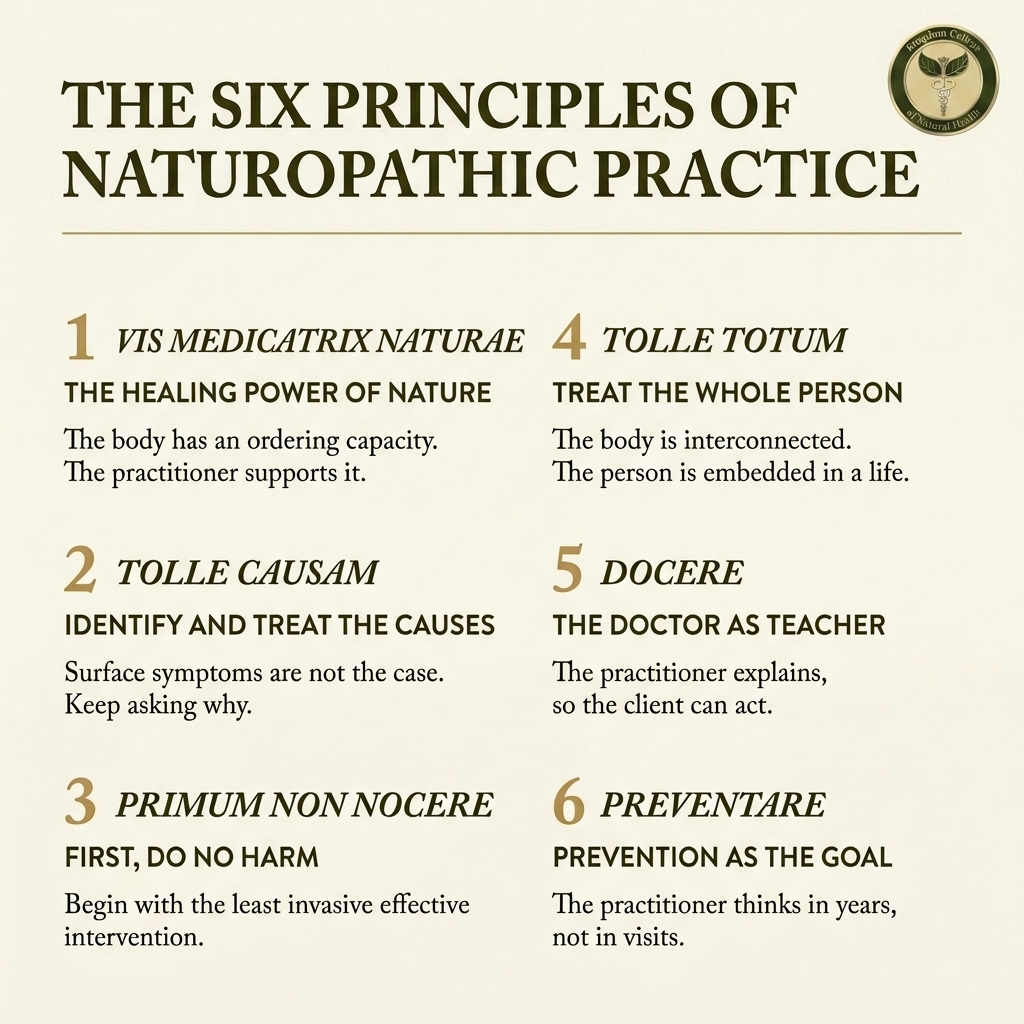
The six principles of naturopathic practice are Vis Medicatrix Naturae, Tolle Causam, Primum non nocere, Tolle Totum, Docere, and Preventare. They form the philosophical framework that distinguishes legitimate naturopathic practice from a generic natural health approach. Each principle shapes how a naturopathic practitioner thinks about case taking, treatment selection, the therapeutic order, whole-person assessment, patient education, and long-arc prevention. KCNH offers Bachelor’s and Doctoral degree programs in natural health that anchor these principles across every subject in the curriculum.
Most prospective students of natural health spend their first five minutes on a program’s website looking at the visuals. The fonts, the color palette, the photography, the testimonials. Within those five minutes, an impression forms about what kind of institution this is. The impression is mostly aesthetic, and the aesthetic does not tell the truth about what the program actually teaches.
A serious student knows this. Polish does not equal depth. A heavily branded site with curated photos can teach almost nothing of substance. A quieter site with less production gloss can teach a philosophically grounded practice that produces capable, thoughtful practitioners. The substance is not in the aesthetic. The substance is in the framework.

The framework that anchors legitimate naturopathic practice is not new. It has been articulated, refined, and carried forward for more than a century. It is summarized in six principles, each named in Latin in keeping with the medical tradition the principles emerged from. These principles are not slogans, and they are not philosophical decoration. They are the working logic that shapes how a naturopathic practitioner thinks about a client, a case, and a course of action. Without them, a practice is something else, perhaps useful, but not naturopathic in any meaningful sense. With them, a practice has a working compass.
These six principles are what a naturopathic education is actually teaching, underneath the curriculum’s specific subjects. They are also what a serious student is looking for when evaluating where to study.

Vis Medicatrix Naturae (The Healing Power of Nature)
The first principle is Vis Medicatrix Naturae, the healing power of nature. The phrase comes from Hippocrates and asserts that the body has an inherent ordering capacity, a self-regulating intelligence that, when supported, tends toward health. This is not a poetic flourish. It is a clinical orientation that changes how the practitioner thinks about a case.
The naturopathic practitioner working from this principle does not see the body as an inert system that needs to be managed. The practitioner sees the body as already trying to do something. A fever is a defense the body is mounting, not just a problem to suppress.
Inflammation is sometimes a repair signal, not always pathology. Fatigue is sometimes a legitimate request for rest the body cannot get otherwise. The practitioner asks what the body is already doing and what it needs to do that work better, instead of asking what intervention will produce the result the practitioner wants.
This orientation changes case taking, treatment selection, and the framing of progress. A practitioner who works from this principle is willing to be patient with the body’s own timing in a way that a practitioner trained to override symptoms quickly is not. The practitioner trusts that the body, given the right conditions, will mostly do its own work. The role of the practitioner is to remove obstacles, supply what is missing, and stay out of the way of recovery already underway.
Vis Medicatrix Naturae is also the principle that protects naturopathic practice from becoming a parallel pharmaceutical model. Substituting herbs for drugs without understanding this underlying philosophy is natural pharmacology, not naturopathic thinking.
Tolle Causam (Identify and Treat the Causes)
Tolle Causam translates roughly as to seize the cause, or to remove the cause. The principle directs the practitioner to find and address what is actually driving a person’s presentation, not to manage surface symptoms while the cause continues unchecked. This sounds straightforward and is not. It is the principle most often invoked in naturopathic marketing and most often left unfinished in actual practice.
Real Tolle Causam thinking requires the practitioner to keep asking why. A client presents with chronic fatigue; why. The fatigue traces to poor sleep; why. The sleep traces to a stress response that has not turned off in months; why. The stress traces to an unresolved professional situation, a relational pattern, or a physiological burden the body is carrying. The practitioner who stops at stress without continuing to ask why has named a category, not a cause. The practitioner who keeps asking eventually arrives at a working hypothesis specific to this client’s life, this client’s body, and this client’s history.
This is where naturopathic practice diverges sharply from a quick-fix model. Following the chain of causation takes time. It takes a thorough intake. It takes a second and sometimes a third conversation to see the pattern clearly. The American Association of Naturopathic Physicians describes this principle in terms of removing obstacles to recovery and addressing underlying causes of disease, distinguished by the willingness to follow inquiry through every layer until the actual driver is named.
Tolle Causam is the principle most directly responsible for the depth of naturopathic case taking. A practitioner trained to honor this principle takes longer with new clients, asks more questions, and is comfortable saying that they do not yet know what is actually causing the presentation. The willingness to sit with not-knowing is itself a discipline.
Primum Non Nocere (First, Do No Harm)
The third principle is Primum non nocere, first do no harm. This is the principle most readers will recognize because it has migrated into everyday medical vocabulary. In naturopathic practice it carries a more specific meaning than the conventional admonition to not actively injure the patient. It directs the practitioner toward the least invasive effective intervention.
This is sometimes called the therapeutic order. The naturopathic practitioner begins with the gentlest interventions that address the case at hand and only escalates to more aggressive interventions as the case requires. Sleep, stress reduction, foundational nutrition, and lifestyle adjustments come before targeted supplementation. Targeted supplementation comes before botanical or homeopathic medicines. Those come before higher-intensity interventions. The order is not arbitrary. It reflects the principle that the practitioner should solve a case with the minimum intervention required, leaving the body’s own ordering capacity to do the rest.
This commitment shapes treatment selection in a way that surprises clients new to naturopathic care. A client expecting an immediate prescription-style remedy is often given a sleep recommendation and a meal-timing change first. The practitioner is not being dismissive. The practitioner is honoring the therapeutic order, beginning where the body needs the least intervention to recalibrate.
Primum non nocere also keeps the practitioner honest about what they cannot or should not do. A case that exceeds the practitioner’s competence is referred. A case that needs medical evaluation gets that referral promptly. The principle requires the practitioner to know the limits of what they offer and to act on those limits when a client’s presentation calls for something else. This is the principle most likely to be tested in actual practice and most often the one that distinguishes a practitioner with judgment from one without.
Tolle Totum (Treat the Whole Person)
Tolle Totum, treat the whole person, is the principle most often diluted into a generic call for lifestyle medicine. That dilution loses the specificity of what the principle actually requires. Tolle Totum is not a soft suggestion to consider stress alongside diet. It is a working clinical method that treats the body as an interconnected system and treats the person as embedded in a life.
In practice, this principle means the practitioner does not assess a digestive complaint without asking about sleep, mood, stress, relationships, work, environment, history, and meaning.

Not because the practitioner believes everything is connected as a vague principle, but because in chronic presentations everything actually is connected, and missing the connections produces incomplete assessments. A practitioner who treats only the digestive complaint while the rest of the system is still driving it has not treated the whole person.
The same principle applies to the timeline of a case. Tolle Totum requires the practitioner to take a person’s history seriously. The episode the client is presenting with did not begin last week; it has a history, often a long one, and the history is part of the case. Whole-person clinical assessment requires the practitioner to hold many threads at once and to track them across the months and years a client may be in care.
This is also the principle that draws students toward serious naturopathic study in the first place. The student notices that mainstream care often treats the complaint and stops. The student wants to learn how to treat the person. Programs that teach this principle teach it across every subject, integrating physiology with nutrition with botanicals with case taking with mind-body work. KCNH organizes its degree programs across many specialties so students learn this integration in depth, including naturopathy, functional medicine, functional nutrition, and naturopathic psychology.

Docere and Preventare (Teach and Prevent)
The final two principles work together. Docere translates as the doctor as teacher, and Preventare directs the practitioner toward prevention as the goal. These principles connect because the practitioner’s teaching role is what makes prevention possible. A client who understands what is actually happening in their body, what their habits are doing for or against their health, and what they themselves can change is a client who can prevent the same case from returning. The practitioner who skips the teaching has a client who keeps coming back with the same problem.
Docere requires the practitioner to be able to explain. Not in jargon. Not in the language of professional self-impression. In language a thoughtful adult can follow and put to use. This is harder than it sounds. Practitioners who cannot explain their reasoning often have not thought it through. A practitioner who can teach is a practitioner who has done the conceptual work first.
Preventare extends the time horizon of care. The naturopathic practitioner is not only thinking about the presenting complaint; the practitioner is thinking about what the client will face in five, ten, and twenty years given current habits, current burdens, and current direction. Prevention is not generic advice to eat better and sleep more. It is specific guidance based on this client’s risks, this client’s history, and this client’s body. The practitioner asks not only what this person needs now, but what this person will need to have done by the time they are sixty, and works backward from that.
These two principles together describe the long-arc nature of naturopathic care. Clients are not seen for one acute episode and then discharged. They are educated, supported, and tracked across years. KCNH’s doctoral programs in naturopathy, natural medicine, and integrative health take this long-arc thinking seriously, training students to hold both the case in front of them and the trajectory the client is on. Graduates of qualifying KCNH programs are also pre-qualified to apply for AANWP board certification, the non-exam practitioner credential for those whose training carries this kind of philosophical depth.
Six principles. Vis Medicatrix Naturae, Tolle Causam, Primum non nocere, Tolle Totum, Docere, and Preventare. They are not a marketing aesthetic and they cannot be reproduced by branding. They are the working logic of legitimate naturopathic practice, articulated in Latin because they emerged from the medical traditions that gave us the discipline. A program that teaches these principles seriously, woven into every subject across the curriculum, produces a practitioner who thinks and works in a recognizably naturopathic way. A program that teaches around these principles, gesturing at them in marketing copy without anchoring the curriculum in them, produces something else.
Serious students of natural health learn to ask a program a different question than the typical applicant.

Not how does the website look, but what philosophy anchors the curriculum. Not how impressive are the testimonials, but what kind of clinical thinker does this institution produce. The first set of questions is satisfied by aesthetic. The second set is satisfied by substance.
KCNH trains natural health students and graduates committed to this depth of philosophical grounding.