How Bachelor’s to Doctoral Degree Programs Strengthen Professional Standing
KCNH bachelor’s to doctoral degree programs strengthen professional standing by providing structured academic preparation in natural health disciplines. These degrees signal sustained study, intellectual discipline, and defined educational benchmarks. They do not grant medical authority or guarantee outcomes, but they clarify long-term professional identity and readiness.
In natural health and wellness professions, titles are common, but clarity is not. Many individuals describe themselves as practitioners, consultants, coaches, or specialists. Some hold certificates. Some have years of experience. Some have completed extensive academic study.
For those considering formal higher education, one question often emerges: What does earning a degree actually change about professional standing?

When we talk about bachelor’s and doctoral degree programs in natural health, we are not discussing status for its own sake. We are discussing structured academic preparation, intellectual depth, and long-term professional identity. The Kingdom College of Natural Health (KCNH) provides structured degree programs designed to support disciplined academic progression in natural health fields.
KCNH Programs Overview: https://kcnh.org/programs/
This article explains how degree-based education strengthens professional standing, what it communicates, what it does not imply, and how to interpret academic credentials responsibly within natural health contexts.
What “Professional Standing” Really Means
Professional standing is cumulative. It is shaped by:
- Educational foundation
- Intellectual preparation
- Scope clarity
- Communication discipline
- Consistency of identity
In fields where pathways vary widely, degrees provide a defined reference point. A degree does not replace skill. It contextualizes it.
How Natural Health Degrees Differ From Short-Term Training
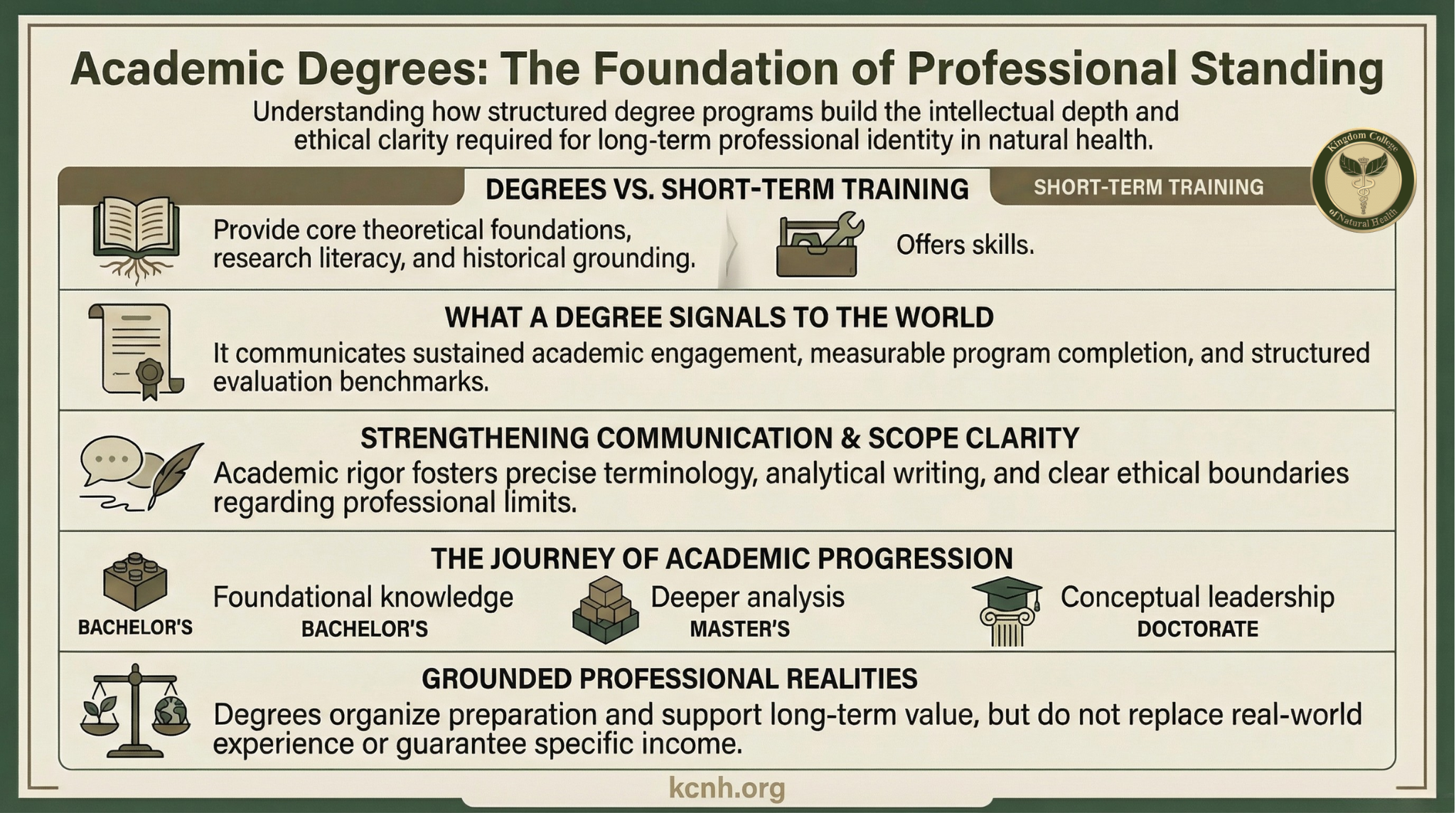
Short-term courses can provide useful skills. Degree programs are broader in scope.
A structured degree typically includes:
- Core theoretical foundations
- Historical and philosophical grounding
- Research literacy
- Structured writing and evaluation
- Ethical instruction
- Scope-of-practice clarity
KCNH Accreditation Information: https://kcnh.org/accreditation/

This broader academic engagement signals depth rather than isolated exposure. Accreditation and program transparency contribute to institutional credibility.
The Signaling Effect of a Degree
Most people cannot directly evaluate your knowledge. When someone sees a bachelor’s, master’s, or doctorate, it communicates:
- Sustained academic engagement
- Measurable program completion
- Structured evaluation
- Defined academic benchmarks
This signal does not guarantee expertise. It reduces ambiguity. In fields where titles can be loosely adopted, a degree represents formalized preparation.
Academic Preparation and Intellectual Credibility
Intellectual credibility often rests on communication discipline.
Degree-based education requires:
- Structured essays
- Analytical argumentation
- Defined citation methods
- Rubric-based evaluation
- Revision cycles
Over time, this discipline affects professional communication.
Graduates often demonstrate:
- Clearer explanations
- More precise terminology
- Logical organization
- Calm boundary articulation
Professional standing strengthens when communication reflects intellectual coherence.
The Signaling Effect of a Degree
Most people cannot directly evaluate your knowledge. When someone sees a bachelor’s, master’s, or doctorate, it communicates:
- Sustained academic engagement
- Measurable program completion
- Structured evaluation
- Defined academic benchmarks
This signal does not guarantee expertise. It reduces ambiguity. In fields where titles can be loosely adopted, a degree represents formalized preparation.

Doctoral Titles and Professional Identity
Doctoral-level natural health degrees often raise questions.
A doctoral degree signals:
- Advanced academic engagement
- Capstone or research-based synthesis
- Extended study duration
- High-level conceptual integration
It does not imply state-regulated medical licensure or clinical privileges. Within KCNH, doctoral programs reflect academic development in natural health disciplines. Maintaining this clarity protects both graduate and public interpretation. About KCNH: https://kcnh.org/about/
How Academic Rigor Strengthens Communication
One overlooked benefit of structured degree programs is improved communication stability. Academic programs require:
- Defined lesson sequencing
- Assignment standards
- Authorship verification
- Evaluation consistency
KCNH incorporates structured online systems and integrity safeguards to reinforce seriousness in learning. Rigor influences how graduates speak, document, and represent themselves professionally. KCNH Legal & Ethical Essentials: https://kcnh.org/legal-ethical-essentials/
Degrees and Scope-of-Practice Clarity
Natural health professions require careful boundary articulation.
Degree programs typically include:
- Ethical instruction
- Role differentiation
- Clear non-medical positioning
- Historical and philosophical grounding
Graduates are often better prepared to communicate:
- What they do
- What they do not do
- When referrals are appropriate
- How to avoid inflated claims
Professional standing strengthens when boundaries are communicated calmly and confidently.
The Layered Credibility of Degree Progression
Progression from bachelor’s to doctorate communicates developmental seriousness.
Each stage reflects:
- Increased complexity
- Increased analytical expectations
- Increased integration
Layered academic progression signals long-term intellectual commitment. This is easier for others to interpret than self-described experience alone.

How Degrees Support Long-Term Career Stability
Professional standing influences longevity. Structured degree programs often support:
- Conceptual adaptability
- Research literacy
- Documentation discipline
- Leadership readiness
As industries evolve, those with strong academic grounding adapt more effectively because they understand principles, not just techniques. Faculty oversight contributes to academic continuity. KCNH Faculty & Staff: https://kcnh.org/faculty/
What Degrees Do Not Do
Clarity prevents exaggeration. A degree does not:
- Guarantee income
- Guarantee client outcomes
- Replace ethical responsibility
- Automatically establish public authority
- Substitute for real-world experience
Professional standing is sustained by conduct, not credentials alone. Degrees organize preparation. Behavior sustains credibility.
International Recognition and Academic Portability
Academic degrees are globally recognizable milestones.
While regulatory systems differ by country, bachelor’s, master’s, and doctoral degrees are widely understood educational markers.
This portability can reduce interpretive barriers in international natural health environments.
Credential Stacking vs. Academic Depth
Collecting short credentials may broaden exposure. It does not always create intellectual cohesion.
Degree programs are designed to:
-
- Integrate disciplines
- Build progressive mastery
- Establish theoretical continuity
- Develop analytical depth
Integration strengthens professional standing because it reflects synthesis rather than accumulation.
When a Degree Is Most Appropriate
A degree pathway may be appropriate if you:
- Seek structured academic progression
- Value intellectual depth
- Want long-term professional identity
- Prefer defined evaluation standards
Clarity about readiness supports better outcomes. Tuition Information: https://kcnh.org/tuition/
Ecosystem Contribution to Professional Stability
Structured degree programs contribute to broader field stability by supporting:
- Clearer role definitions
- Reduced public confusion
- Improved documentation practices
- More consistent communication
KCNH graduates may also pursue additional professional pathways if aligned with their goals. These are optional pathways, not mandatory progressions.
Board Certification Eligibility:
https://kcnh.org/board-certification/
Licensure Eligibility Information:
https://kcnh.org/license/

A Grounded Interpretation of Academic Advancement
Bachelor’s to doctoral degree programs in natural health represent structured intellectual development.
They signal:
- Sustained commitment
- Defined academic standards
- Integrated learning
- Analytical growth
- Professional maturation
They do not replace experience. They organize it. They do not guarantee authority. They clarify preparation. For individuals who value disciplined academic progression, structured degree programs provide a stable foundation for long-term professional standing.